Category Archives: Recent Guests

18 March 2026

Bob Fox

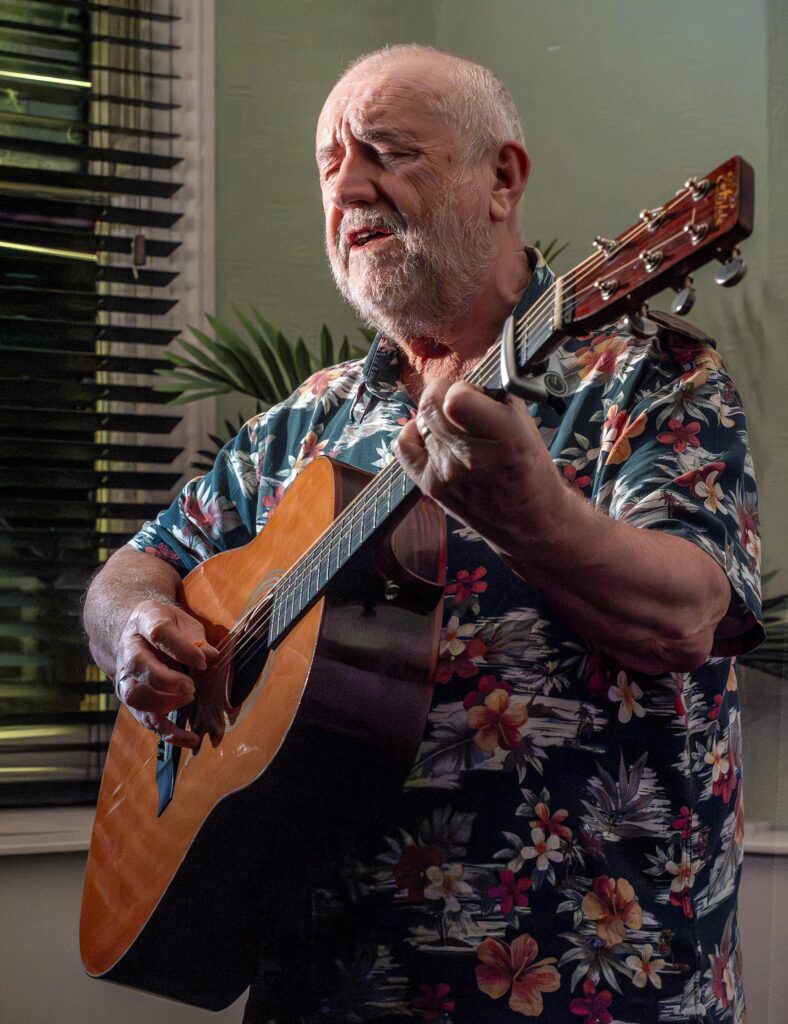
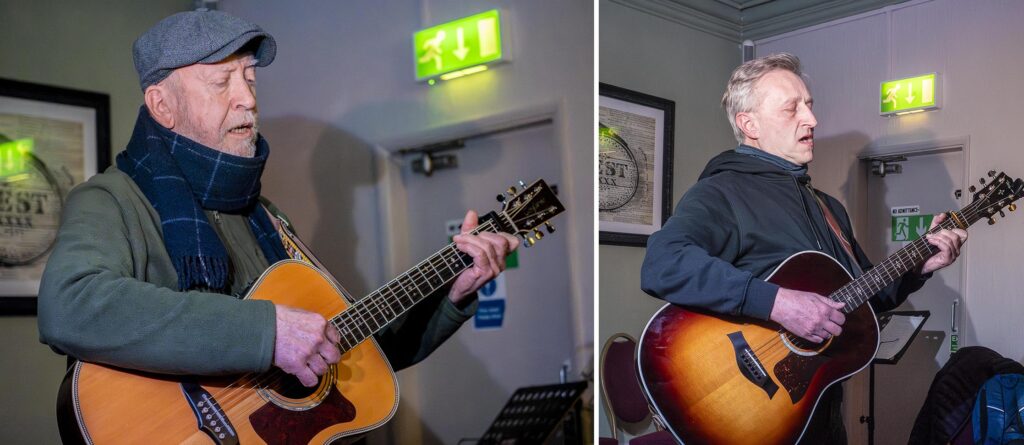
Bob Fox playing guitar

On Wednesday, 18th March, our guest at the Carrington Triangle was Bob Fox from Seaham, a former coal mining town, about six miles south of Sunderland, hence he specialises in songs from the North East.
After the usual half hour of floor singers, Bob moved onto the ‘stage’ with an ease of manner, immediately engaging with the audience through interesting and amusing stories and song introductions, He began with My Love is in America by Chris Leslie, a wistful, haunting song about a young man whose girlfriend is forced to leave him in order to emigrate to the States with her father. This was followed by a song about the Sunderland naval hero, Jack Crawford, sometimes called The Hero of Camperdown. It tells the story of how he ‘nailed his colours to the mast’ during that battle in 1797.
The third song, The Year Turns Round Again, was from the theatre production of War Horse, in which Bob appeared as Song Man, followed by another song from that production, Learning to Plough, where Joey the horse had to be taught how to ‘ plough a good furrow’ for a Devon village competition.
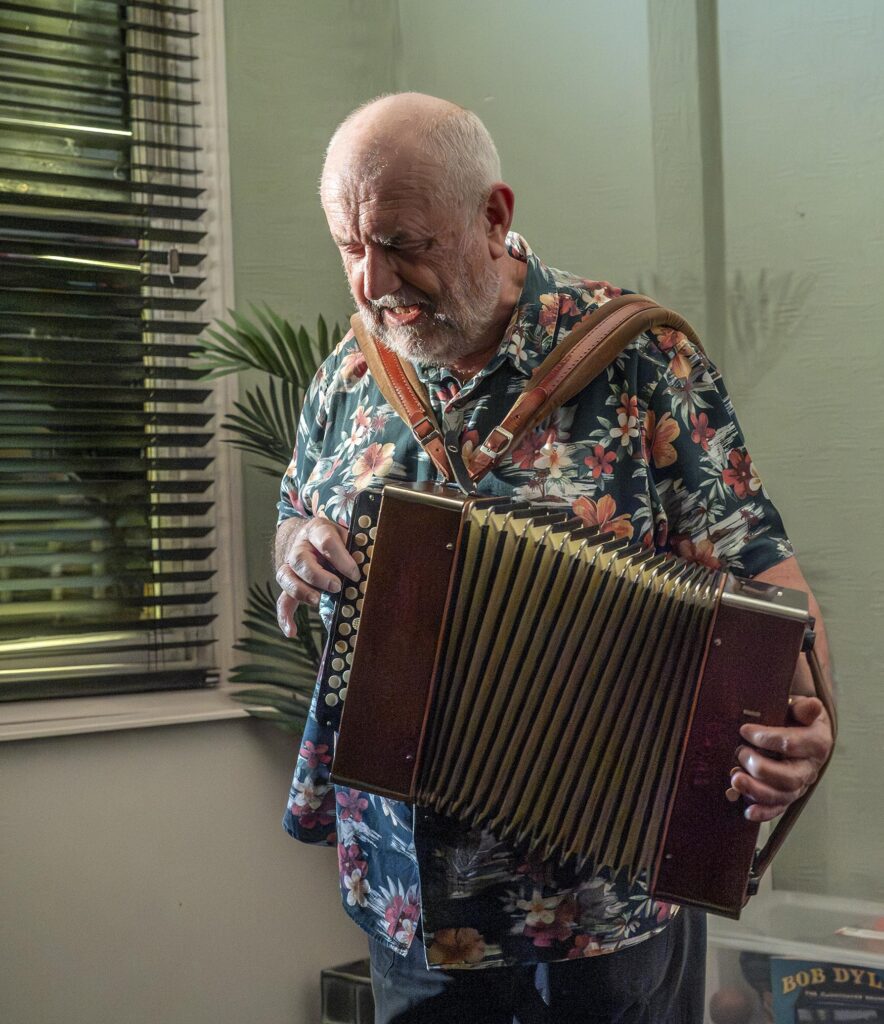
Bob told us that he had to learn to play the melodeon for War Horse, and had one made in Gateshead to look like an early twentieth century instrument (Just a bit of info for melodeon enthusiasts!).

Bob Fox playing melodeon

Towards the end of the first set came a song by Jez Lowe called Greek Lightening about a couple trying to get by on benefits, dreaming of a holiday in the Greek islands, but having to settle for day trips to Roker and Whitley Bay. As a northerner myself, I don’t happen to think those choices were a bad alternative, but a life on benefits is not much fun.
Bob began his second set with Champion at Keeping Them Rolling about old-style long distance lorry drivers. It was written by Ewan MacColl, and Bob did mention, in his humorous way, that Ewan, who was really English pretending to be Scottish, sang as a Geordie (well, why not ?!).
Peppers and Tomatoes was next, a political song by Ralph McTell referring to how the Orthodox Serbians and Catholic Croats got along with each other until Serbia, supported by Russia, went to war, intent on divide and conquer tactics.
The Whitby Tailor  was a rather quirky music hall song in which a shy young man, trying to date a young woman, suggests, after too many drinks, that they swap clothes. He ends up half naked while she runs off in his trousers, the pocket containing all his money!
Bob followed with such well-known Geordie songs as The Bonny Gateshead Lass, When the Boat Comes In, The Lampton Worm and The Water of Tyne, ending this very entertaining evening with ‘ Big River’ by Jimmy Nail, another well-known Geordie.
Inspired by Bob’s mention that Sunderland people were not Geordies but Mackems, I did a bit of research into these names.  Apparently Mackem originates from Sunderland’s shipbuilding heritage, ‘we mack’em and they tack’em’, meaning, of course, ‘we make the ships and they take them out’. The name Geordie, on the other hand, possibly originates from the support Tynesiders gave to King George 2nd, during the 1745 Jacobite rebellion, or perhaps the nickname for local coal miners who used safety lamps or ‘geordie lamps’ as designed by George Stephenson. There is much rivalry between Geordies and Mackems, stemming from sides taken during the Civil War, industrial competition and football teams.
Just thought you might like to know all that.
Yes, it was, in Geordie-speak, a champion night, having that canny lad back after a ten year gap. We all enjoyed his many chorus-songs, his powerful ­­– and at times very passionate ­­–  singing, skillful guitar work, his melodeon playing, and well, his northernness!

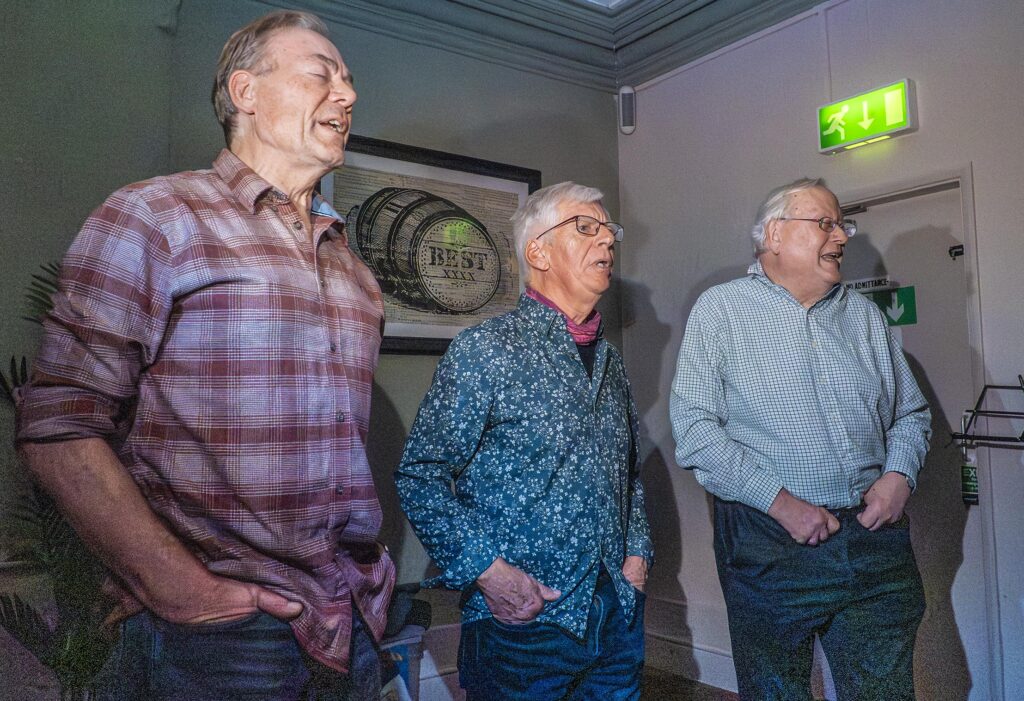
Floor singers Matt Blick and Phil Harrison
Great floor singers again: Matt Blick and Phil Harrison, even cooler than usual

Maureen McGuinness, on behalf of Carrington Triangle folk club.

18 February 2026

Paul Carbuncle Album Launch

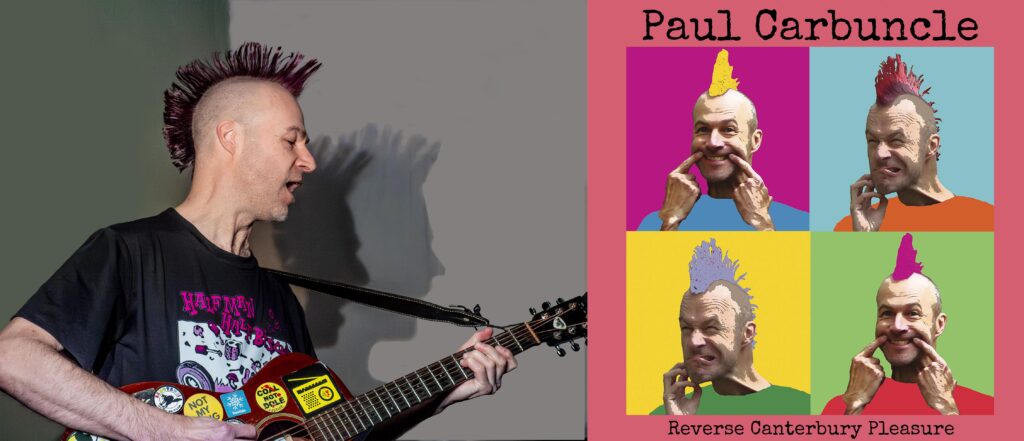
This month’s guest was Paul Carbuncle, launching his new CD Reverse Canterbury Pleasure. The title is the name of a peal of bells: you can interpret it as you wish.

Paul has connections across a much wider social activist and music scene than folk clubs like ours, so he attracted a wide range of admirers. Often it’s the job of a guest performer to win over the audience and to provide some background and justification for their songs, but we were all on Paul’s side (and knew a fair few of the songs) right from the start, so he just got on with the music, and gave us two well-filled sets – 29 songs in all. Many were from the new record (Drinking Money, My Name is Dessie Warren, A Tree Song), but there were welcome favourites like Cookie’s Old Cries of Nottingham (with a tribute to Cookie’s help in recording and performing on the CD), Pig Farmer, Isambard, Deport First, The Mermaid (with Blossom demonstrating the ‘three times round’ bit), Ben Kenobi….

Paul’s performances are always powerful and impressive. His singing is beautifully clear, so it’s possible to make out every word (a skill that’s not that common, unfortunately), and, more importantly, he conveys the meaning of every word, too – and all the songs have a message or a story. His guitar style is quite idiosyncratic, and often fast and furious, but the power and vigour of this playing can be deceptive: it’s not all sound and fury. His left hand is wonderfully dexterous up and down the fingerboard, and the right hand is really precise, as well as rapid.

The CDs Paul brought sold fast, and he was kept busy in the interval with a queue of people wanting them signed (if you missed your chance, CDs and downloads are on Bandcamp). There were mugs and T-shirts available, too. There was already someone wearing a T-shirt by the beginning of the second half.

At the end of the night, Paul had difficulty getting away, because of the queue of people waiting to tell him what a great evening it had been. They were right.

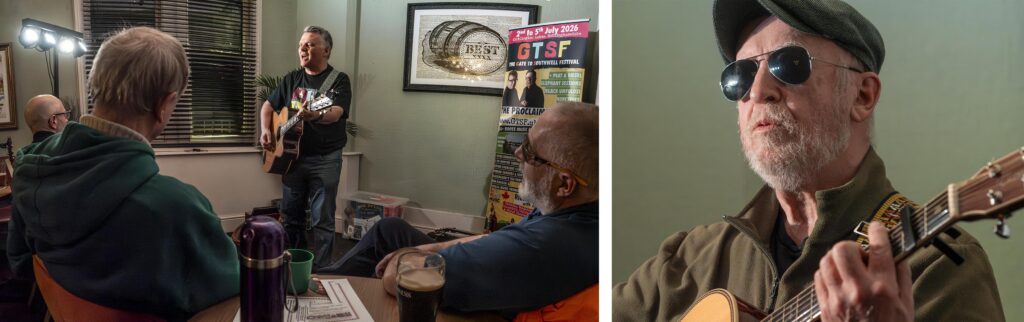
Phil Harrison and Rob Duley, two of our excellent collection of floor singers

Hugh Miller

Wednesday 10th December

Notts Alliance

Notts Alliance packed the club last Wednesday, 10 December.

The group has been an important and respected part of the Nottingham traditional music scene, with some changes in membership, since 1972. The current lineup, Chris Orme, Phil Hardcastle and Stephen Bailey, dates from 1986. So there were many old and new familiar faces of singers, dancers, and musicians in the audience. I remember Notts Alliance from back in the 70s, when the much-missed Sid Long was in the group, and I was certainly pleased to be there this week. Although they’re active and important around Nottingham, they hadn’t been guests at Carrington for a long time, not since before the pandemic.
They gave us an entirely unaccompanied set with striking harmony singing, sharing leads across all three. They’re all grand singers, but I particularly enjoyed Phil’s clear tones coming through on some of the quieter numbers. Steve effortlessly shifted across a very wide range for his harmonies.
Although Notts Alliance were always part of the local traditional scene, they gave us a lot of contemporary songs mixed in with the old songs*. They started with Richard Thompson’s stirring Wall of Death and ended with Jez Lowe’s Back in Durham Jail. But in between there were several old songs like Creeping Jane (a tribute to Joseph Taylor) and a lovely version of Bushes and Briars, with several verses which aren’t usually heard.
We had seasonal songs too – a wassail, and John Jacob Niles’ I Wonder As I Wander (probably not as traditional as Niles made out, but at least 90 years old, so it’s become part of the repertoire by now – and it’s a nice song).
Chris has raised the telling of bad jokes to a fine art, and that livened up the evening, too. Some of the jokes even made Phil and Stephen wince.
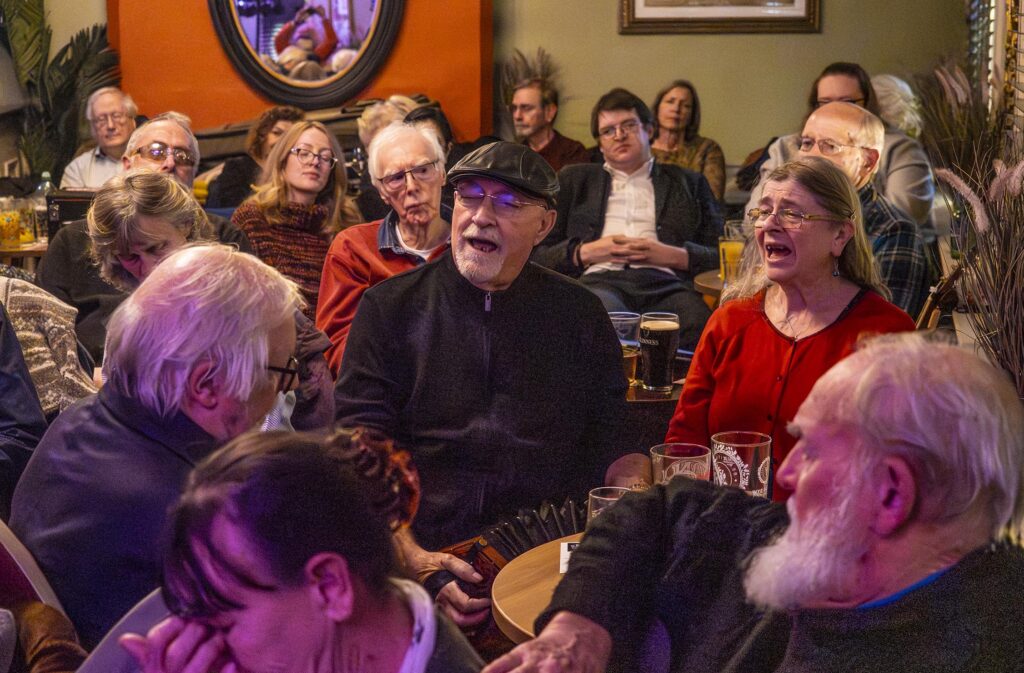
In all, a great evening, with powerful chorus singing from the audience, as always, and a great feeling of mutual support around the room coming out of the strength, depth and longevity of the local scene.
We hope it’s not so many years before we have them back again.

Notts Alliance’s long history brought some important singers from the Nottinghamshire and Derbyshire folk scenes to the club. Here’s Keith Kendrick and Sylvia Needham giving us a song, with Al Atkinson and Ken Brammah listening.
Hugh Miller

*My classification of ‘contemporary’ is a bit biased: Ewan MacColl’s Radio Ballad songs (they gave us a few) from 1960 or so are still modern as far as I’m concerned.

Previous guests: 12 November

Doug Eunson & Sarah Matthews

Doug and Sarah are longstanding Derbyshire artists who had been our guests before Covid, so longstanding members expected a mix of traditional songs and dance tunes, some of them by Sarah and Doug. They have had 30 years of playing together in ceilidhs and folk clubs, which showed in their clear introductions and well-planned set list. The Taoist Tale from Doug, a song by Tucker Zimmerman about the uncertainty of luck, was followed by hornpipes and the Child ballad Willy’s Lady where Sarah shone.

They soon let us join choruses of In Praise of Alcohol, a Robert Service poem, and the 16th century Jolly Good Ale and Old. We had dance tunes from Belgium and France, Orange in Bloom and a lovely tune written by Chris Wood. Sarah followed the Thomas Raine song Fourpence a Day with her composition Gathering Round about the joy of participation in celebration. When we asked for an encore, they gave us the Padstow May Song which let us finish the night with a rich chorus.


Previous guests: 15 October 25

Culverake

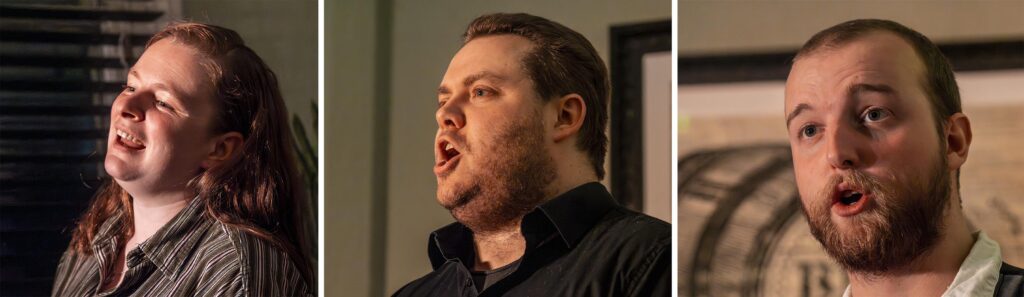
Lizzie Hardingham. Matt Quinn, and Seb Stone

Culverake are the trio of Lizzie Hardingham, Seb Stone and Matt Quinn. They sing unaccompanied, with a high proportion of traditional songs. We had been impressed by their set at the Gate to Southwell Festival earlier in the year, and were pleased to invite them to the club.
They gave us a splendid set, starting at high intensity with a May Song in which power from Matt and Seb was lifted by Lizzie’s bell-like top line.
Most of the songs they did for us are on their just-released album Unto the Sky. There were several unusual variations on well-known songs, like a Scots version of John Barleycorn, and Three Old Jolly Sportsmen, which started off as the well-known highwayman ballad Two Butchers, but then swerved off in an unexpected direction.

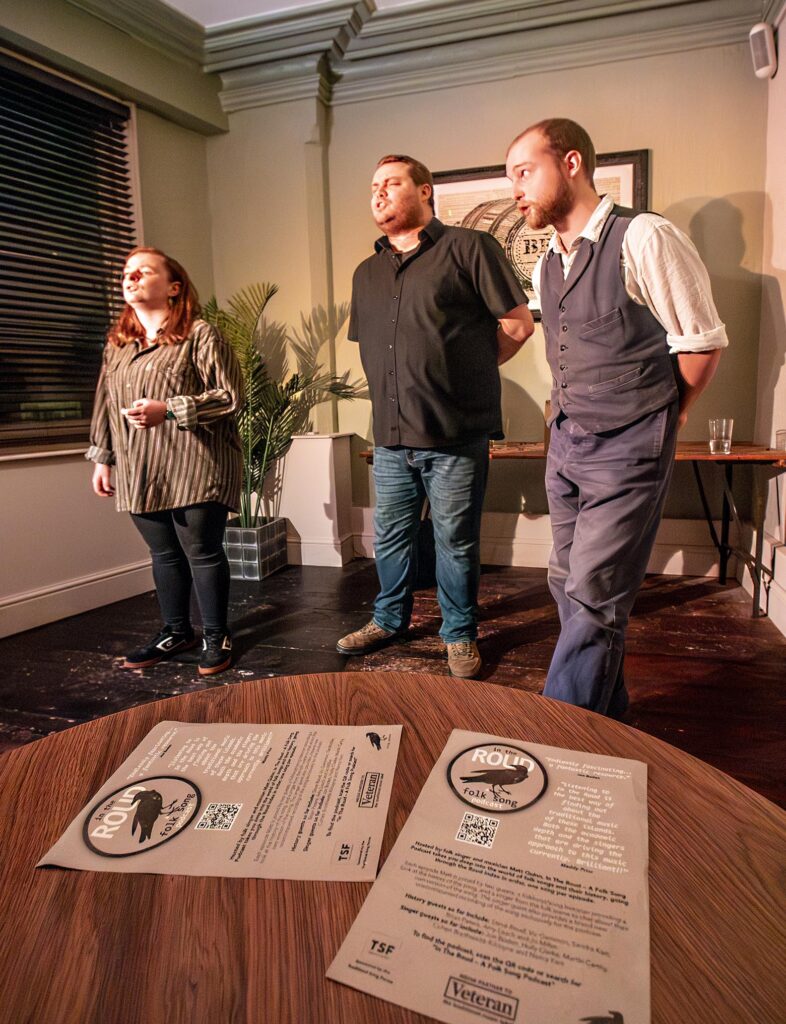
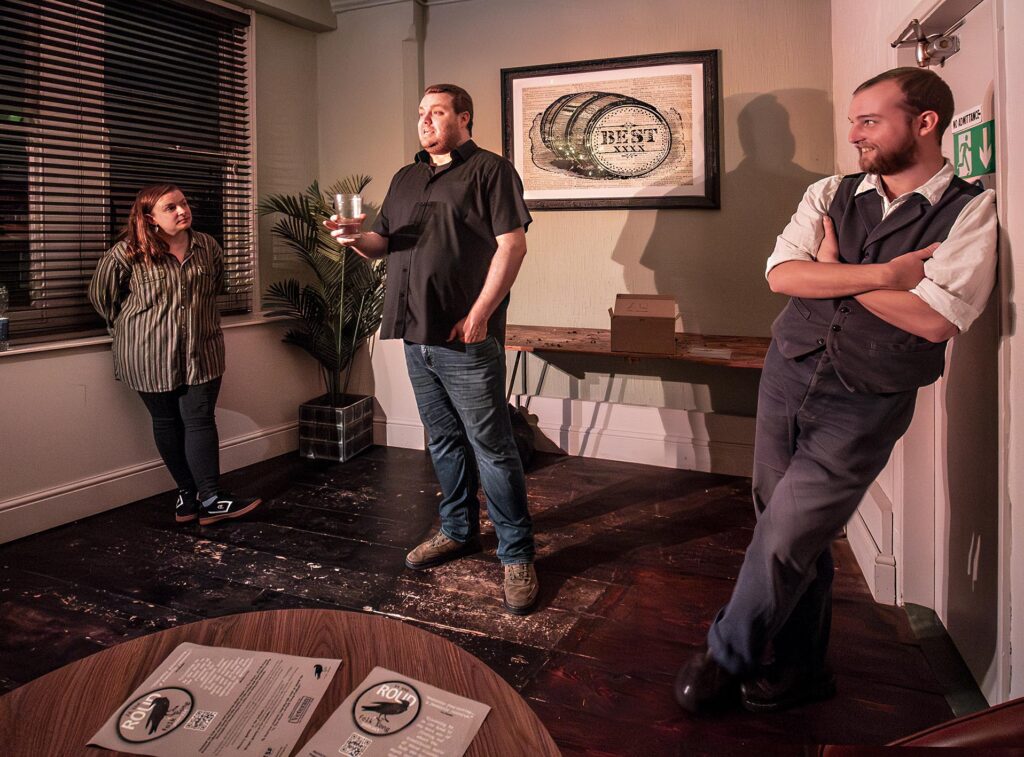
Note ‘In The Roud’ flyers in the foreground

Three-part harmony is Culverake’s feature style, dense, complex, and beautifully sung. All three are worth listening to as solo singers, though. This was apparent in one- or two-line solo parts in the arrangements and in the melody leads, which were shared among all three. Examples were Seb’s beautifully clear and gentle lead in You Lads and Lasses, a version of Seeds of Love, Matt in Down by the Seaside, an incomplete broken token song (doubly broken, I guess), and, in particular, Lizzie on Rolling Down to Old Maui. She sang it with a lovely varied and dancing rhythm and bluesy touches, which really lifted what is sometimes a rather stolid belt-it-out song. Great.
I loved the harmonies (I have always loved vocal harmony, right back to Peter, Paul and Mary and Le Mystère des Voix Bulgares), but I would also have enjoyed hearing a bit more solo singing from each of them.
Another of Culverake’s strengths is clear diction. It’s important to hear the words.
Matt gave us plenty of detail about source singers and variants of the songs. Not surprising, given the great depth of information in his podcast In the Roud, which is a series of really valuable in-depth analyses by experts of songs in the Roud Index – well worth following up on YouTube or other podcast sites. He’d put out flyers on our tables: I hope some of them were taken away and followed up. Our ballad group has found the series very useful.

Lizzie and Seb relax while Matt gives the lowdown on the next song

The intensity they started with was maintained to the last, even in gentle songs like Sweet Thames Flow Softly. They ending with bouncing through Mike and Lal Waterson’s Rubber Band as an encore.

As usual on guest nights, we had a few floor singers to start off each half. It’s good that we have a collection of excellent and reliable singers, like ‘The Old Flames’ (Mike and Jane), Sarah Farrell, and Phil Hind, who can give those who come for the guest nights a positive impression of the club in general.

Jane Tracey and Mike Wareham

Our next guests will be Sarah Matthews and Doug Eunson on the 12th November. They’ll be great, too.

Hugh Miller

Recent guests: Cohen Braithwaite-Kilcoyne 16 July

Cohen Braithwaite-Kilcoyne

Cohen Braithwaite-Kilcoyne’s powerful and intense singing, brilliant musicianship, wide choice of material, and rapport with the audience left us captivated, a bit amazed, and maybe a little stunned (he is satisfyingly loud) last Wednesday evening.
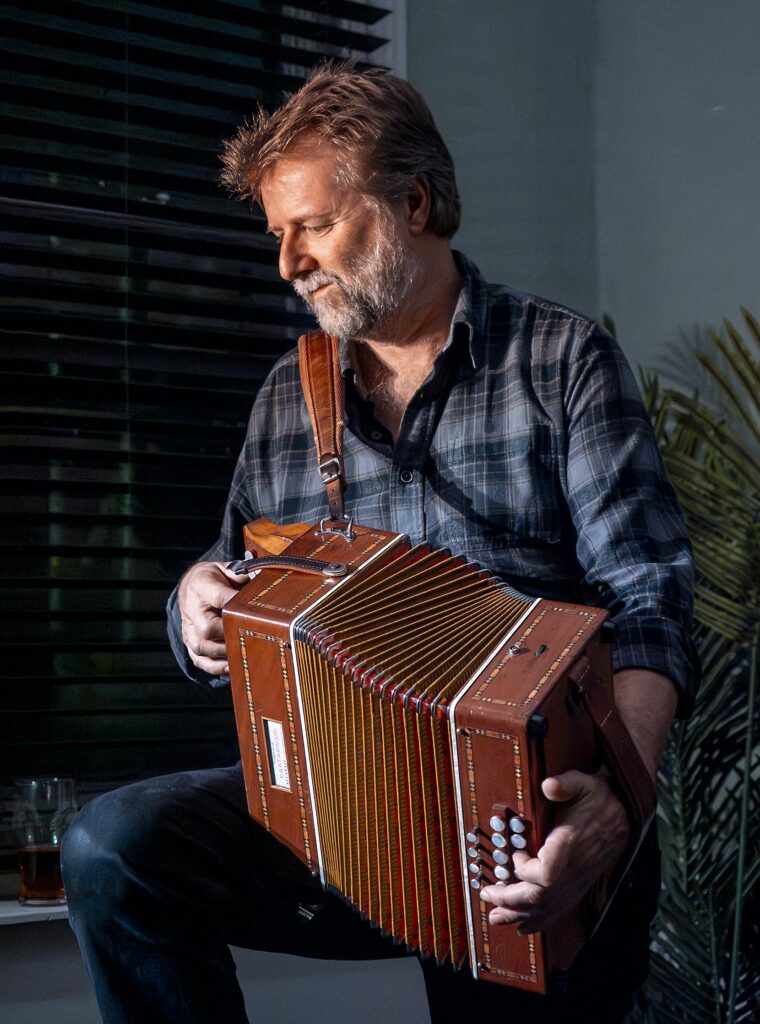
He was playing anglo concertina and a hybrid converted melodeon-accordion based on a pre-war Hohner Lucia, which gave melodeon-style punch and drive on the right hand but a full range of bass chords, which he used very effectively, on the left. Effectively an instrumental hot rod.
Almost all his material was traditional, ranging from classic early twentieth-century songs collected by people like Lucy Broadwood and Ralph Vaughan Williams, through to striking material from his latest CD, Play Up The Music, a collection of English-origin songs as sung in the Caribbean and by African-American artists in the USA. This included Pretty Little Sailor, a version of Soldier, Soldier, Won’t You Marry Me? which many of us learned at school, and a mesmerisingly powerful version of Little Musgrove.

The depth and range of his instrumental playing was wonderful. On the melodeon, he started the evening with a lively and powerful version of two country dance tunes and then moved on to a representation of some Welsh fiddle tunes from a player who ‘knew a lot of notes, and was determined to play every single one of them’ (and Cohen showed us just what that meant). On the concertina he gave us ‘a sailor’s hornpipe, as it would have been arranged by J.S.Bach’ – completely convincing, very funny, and a virtuoso performance – followed by his own very moving Fantasia on a West Indian Burial based on the songs traditionally sung at funerals to help to guide the souls of the dead back to their home in Africa.
It wasn’t just an evening of varied songs, powerful singing and wonderful playing. He was very much with us as an audience. Many of his songs had choruses or refrains, which suited the club’s good reputation for chorus singing, and for almost every piece he gave us informative, interesting, amusing and sometimes touching introductions and explanations. Both sets were closed off with just the right kind of rousing finales: a less-than-serious music hall song from Vesta Tilley in the first half, and a remarkable concertina piece, ending with whirling the instrument round his head to use the Doppler Effect to imitate the sound of bells, at the end of the evening. Good stuff.

Go and see him again if you can, either solo or in the group Granny’s Attic, with George Sansome and Lewis Wood (who are playing at Gunthorpe Village Hall in November).

Hugh Miller for the committee

Recent Guests: Clarke Camilleri 11 June

The welcome return of Clarke Camilleri to the Carrington Triangle proved to be a delightful evening.

Clarke actually joined the club in 2016 and became a regular performer here, where, with a background in the blues, he was introduced to British traditional music.  Since then he has travelled widely, both as a solo artist and with other musicians, including Angeline Morrison’s band.  He features on her award-winning album, The Sorrow Songs: Folk Songs of Black British Experience.
Clarke has returned as an experienced and charismatic performer, very much at ease with the audience, who responded warmly to his excellent musicianship, stories and humour, even enjoying the times he interrupted himself with bursts of laughter during a couple of his songs! We were delighted to welcome him back.
He brought with him two guitars, a banjo and a harmonium.  He began the evening with Anji on guitar, followed by Last Night I Had the Strangest Dream, an anti-war song by Ed McCurdy. Worried Man’s Blues came next, a traditional song recorded in 1930 by the Carter Family, based on the post-Civil War era when plantation owners, still on the lookout for cheap labour, were keen to get black men arrested for the slightest offence to work in chain-gangs.
Clarke performed several British folk songs, a couple by Cyril Tawney, and MacColl’s ‘Shoals of Herring’.  He also included a Beatles, and a Dylan song.  Before he sang Bert Jansch’s arrangement of Blackwaterside, he told us that he first heard it played here by a regular performer Phil Harrison, who was also in attendance that night.

At one point in the evening, he brought onto the stage Jinda Biant, a blues/folk musician and a ‘best mate’ who accompanied him in a song called Nice to meet you Syrilla, a very lively and fun experience, seemingly, for both of them, and also for us!
I haven’t yet mentioned Clarke’s original songs. Several that he sang are on his 2020 album, The Rollin’ Hills of Home. The title song is about his walks in the Peak District with his mother and brother. The Spirit is an inspiring song about not allowing the establishment to crush us. The spirit will always rise again! Keep the World Singing Round reminds us that no matter what awful things are happening in the world, singing can help bring people together in solidarity.
In conclusion, I found Clarke’s performance entertaining, joyful, and full of messages in relation to justice and fairness, and a desire to make the world a better, kinder place for us all.

Maureen McGuinness, on behalf of Carrington Triangle folk club

Our next guest is Cohen Braithwaite-Kilcoyne on 16 July

Recent guests: Wayward Jane

May 28: It was a full house for a wonderful evening with Wayward Jane. The band played a mixture of American Old Timey tunes and songs, flavoured with their own unique Scottish and Irish influences. They also played their own tunes and songs such as The Flood written by Michael Starkey, who played fluid clawhammer banjo all night. Sam Gillespie, a consummate guitarist, who also played wooden flute and bouzouki, was the main vocalist and his high plangent tenor was an important feature of the night. He wrote several of the songs such as the beautiful Everything Changes, backed by perfect four part harmonies from the rest of the band.
Tara Cunningham on fiddle, trained in the Scottish tradition but also fluent in the Old Timey style, spent all night duetting with Michael Starkey on the banjo to great effect. Dan Abrahams on stand up bass and guitar added a mellow punch to the evening.


The band worked together intuitively and clearly enjoyed themselves greatly. This came across to the audience making the evening hugely entertaining. There were too many highlights to mention them all but the last anthemic song Liberty got the whole club singing and the encore Make Me a Pallet on Your Floor was a rousing example of the band’s unique approach. Mike Wareham

One of our floor singers that night was Phil Harrison. Phil has been very busy with other things lately, and hasn’t been able to come to the club for some time, and we were all very pleased to welcome him back, and to hear that he should be able to come more frequently again.

Recent Guests: Hase Waits 14 May

Hase Waits are sisters Hannah Bainton and Heather Thomas & Heather’s husband James. As our May guests Hannah and Heather both played flute and a range of whistles, backed by James on rhythm guitar.
The two sisters have been playing together since they were about six, and that experience showed itself in wonderful coordination and collaboration on the tunes they played. They played in various combinations: flute duets, high and low whistles, or – my favourite – two low whistles with lovely harmonies. The precision and interweaving of parts in the faster tunes was great.

There were a few songs, both traditional and modern. I would have liked more, but since we don’t have a PA, it was a bit difficult for Hannah’s voice, however good, to cut through the accompaniment.
James did a couple of pieces on hurdy-gurdy, with Heather on flute and Hannah doing lovely lively percussion on cajon, which worked really well. The second one was by audience request, because we enjoyed the one in the first half so much.
A good night, full of lively music. Hase Waits will be at The Gate To Southwell Festival. 3-6 July, probably with an expanded lineup. They will be worth seeing.
p.s. some of us really liked the Green Man fabric design of Heather’s dress.

Hase Waits were backed up by some of our floor singers, as usual. Here’s our longest-standing member, Phil Hind, leading the room in chorus.

Recent guests, April: Brian Peters

Brian Peters

While acoustic music of all genres is always appreciated at the Carrington Triangle, the evening of April 9th was especially dedicated to a celebration of the traditional folk idiom, powerfully presented by our guest performer, Brian Peters.
     Brian has been described as one of the English folk scene’s great all-rounders, a compelling singer and multi-instrumentalist, and he certainly lived up to his reputation that evening. With his vibrant, clear voice, anglo-concertina, guitar and melodeon, he put the traditional material across in a skilful, relatable manner, and, seeming very much at ease, appeared to enjoy himself as much as his audience did, introducing his songs and tunes with humorous anecdotes and well researched knowledge of their origins.
    His repertoire included Child ballads, songs collected by Cecil Sharp, and one or two relatively recent songs, for example Chris Foster’s ‘Trespassers will be Celebrated’ about the mass trespass in the Peak District in 1932 in support of opening up the land again to ramblers, which, he told us, was a subject close to his heart as a walker himself.
    Brian sang several humorous songs including a music hall song ‘Chips and Fish’, and ‘ The Molecatcher’.  Many of the songs are of course well known to folk club audiences, but he seems to have discovered self-styled ‘obscure versions’ which included his final song, The Wild Rover’ from Hampshire.  Other songs included ‘Turpin Hero’, ‘Adieu my Lovely Nancy’, and ‘The Manchester Rambler’.
     I believe, judging by the favourable comments from members of the audience, that Brian’s charismatic performance was much appreciated.

Maureen McGuinness, on behalf of the Carrington Triangle folk club